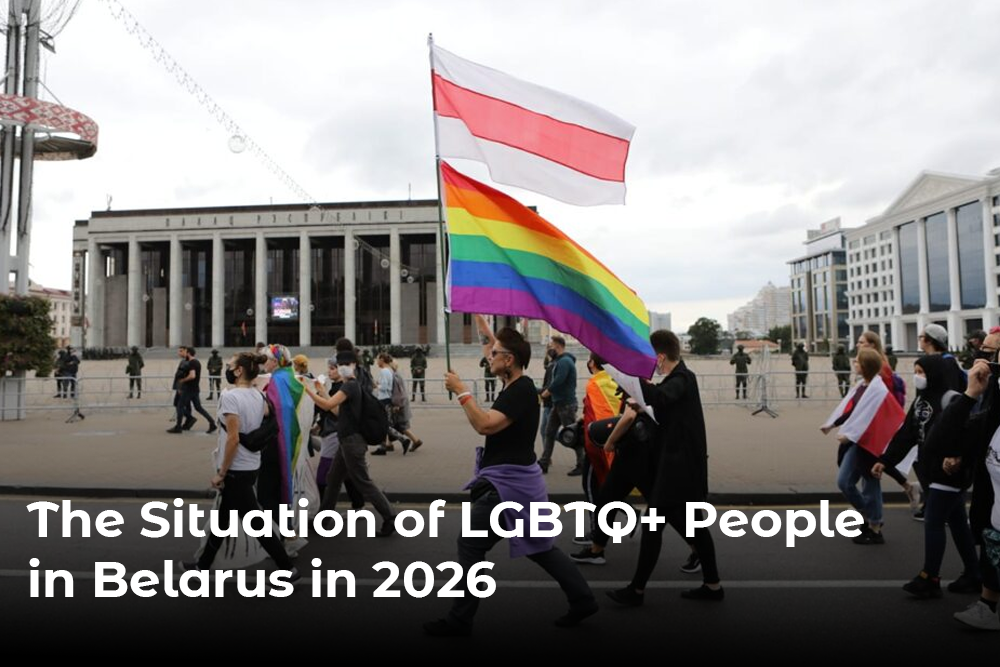
Belarus has long been among Europe's most repressive states towards LGBTQ+ people. But what is happening now goes beyond informal discrimination or social prejudice. Since 2020, Belarusian authorities have been systematically building a legislative framework that criminalises not only LGBTQ+ identity, but any expression of it. The result is a legal environment in which living openly as a queer person — or even expressing support for those who do — can lead to criminal prosecution.
This article is based on a country situation assessment prepared by Legal Initiative in June 2026. It documents the legislative measures, enforcement practices, and what they mean for LGBTQ+ people in Belarus and abroad today.
A Country Under Repression
Any analysis of the situation of LGBTQ+ people in Belarus must begin with the broader context. Following the mass protests of 2020, when hundreds of thousands of Belarusians took to the streets to contest the results of a falsified presidential election, the Lukashenko regime launched a systematic crackdown that continues to this day.
As of June 2026, more than 850 political prisoners remain in Belarusian detention facilities. More than 7,700 people have been convicted on politically motivated criminal charges since May 2020. LGBTQ+ people are not persecuted in isolation — they are among the groups most acutely affected by a regime that treats any form of difference as a threat.
Belarus currently ranks 46th on the ILGA-Europe Rainbow Map, with a score of just 7.01% — a figure that has been declining steadily since 2019, when the country held 40th place.
The Legislative Architecture of Persecution
What distinguishes the current situation from previous years is the construction of a formal legal basis for the persecution of LGBTQ+ people. Three legislative developments stand out.
Expanded Definition of Pornography
In March 2024, the Belarusian Ministry of Culture adopted Resolution No. 24, amending the official definition of pornographic content. The resolution placed references to "homosexual relations," "lesbian love," and transgender identity within the category of "non-traditional sexual relations," placing these concepts in the same legal category as socially condemned and criminalised conduct.
The practical consequences are clear: any public expression of queer identity — any display of LGBTQ+ identity or solidarity, online or in person — may be legally classified as the production or distribution of pornography. This carries administrative liability under Article 19.7 of the Code of Administrative Offences:
The storage, with the intent to distribute or advertise, or the distribution or advertising of pornographic materials, printed publications, images, films, video films, or scenes of a pornographic nature, or other items of a pornographic character — shall entail a fine in the amount of two to thirty base units.
and criminal liability under Article 343 of the Criminal Code:
- The storage, with the intent to distribute or advertise, or the distribution or advertising of pornographic materials, printed publications, images, films, video films, or scenes of a pornographic nature, or other items of a pornographic character, committed within one year of the imposition of an administrative penalty for the same offences, as well as the production, with the intent to distribute or advertise, or the broadcasting or public display of pornographic materials, printed publications, images, films, video films, or scenes of a pornographic nature, or other items of a pornographic character — shall be punishable by community service, or a fine, or corrective labour for a term of up to two years, or detention.
- The production or storage, with the intent to distribute or advertise, or the distribution, advertising, broadcasting, or public display of pornographic materials, printed publications, images, films, video films, or scenes of a pornographic nature, or other items of a pornographic character, committed for mercenary motives or by an organised group, as well as the distribution, advertising, broadcasting, or display, to a person knowingly under sixteen years of age, of pornographic materials, printed publications, images, films, video films, or scenes of a pornographic nature, or other items of a pornographic character, committed by a person who has reached eighteen years of age — shall be punishable by restriction of liberty for a term of two to four years, or deprivation of liberty for the same term, together with a fine.
Amendments to the Law on the Rights of the Child: LGBTQ+ Identity Classified as Harmful
In July 2025, the Law on the Rights of the Child was amended to classify "propaganda of homosexual relations, gender transition, paedophilia, and childlessness" as content harmful to the mental health of children. The amendment created direct legal risks for parents raising children with values of tolerance and equality — with no legislative definition of what constitutes "propaganda."
Administrative Liability for "Propaganda" — Article 19.16 of the Code of Administrative Offences
The most recent and far-reaching measure is Article 19.16 of the Code of Administrative Offences, signed by Lukashenko on 15 April 2026. The provision:
- prohibits the dissemination, in any form, of information intended to promote to citizens a positive perception of homosexual relations, gender transition, childlessness, or the normalisation of paedophilia;
- provides for administrative liability: for individuals, up to 20 base units; for sole proprietors, up to 100 base units; for legal entities, between 100 and 150 base units. Where such actions result in a minor being exposed to the said information, individuals face a fine of 20 to 30 base units, community service, or administrative detention; sole proprietors a fine of 100 to 150 base units; and legal entities a fine of 150 to 200 base units;
- carries extraterritorial reach: content published abroad but accessible to a Belarusian audience may serve as grounds for prosecution within Belarus.
UN human rights experts have described this legislation as a dangerous escalation, noting that it equates legitimate human rights work with an administrative offence and risks creating further grounds for the persecution of already marginalised groups.
Enforcement: What This Looks Like in Practice
Legislation is only part of the picture. Equally significant is how it is enforced. Documented cases point to systematic, targeted, and often violent persecution.
Raids, Detentions, Surveillance
Between 2020 and 2025, TG House documented 46 detentions of LGBTQ+ individuals, including 16 transgender people. This figure is likely an undercount, owing to state censorship and the well-founded fears that deter many victims from seeking help.
In September 2024 alone, between 15 and 20 people were detained; by November, the total number of those detained had exceeded 30, including at least eight transgender individuals. Raids targeted closed cultural events and private gatherings — spaces that the community had regarded as relatively safe.
By 2025, alongside formal legal measures, authorities were making increasing use of covert methods: entrapment through dating applications, undocumented "preventive conversations," pressure on family members, and attempts to coerce individuals into cooperating with law enforcement.
Criminal Prosecution for Personal Photographs
Criminal charges under Article 343 of the Criminal Code ("pornography") have been brought against LGBTQ+ people on the basis of non-explicit personal photographs posted on social media. In 2024, in three documented cases, transgender individuals were charged under this article for images that contained no pornographic content but were classified as such by the authorities.
In September 2024, three transgender women in a regional city in Belarus had their homes searched under the guise of an investigative measure. At least one was charged under Article 343. Around the same time, another transgender woman was detained on the street in Minsk and subjected to violence and humiliation at a police station — her home had already been searched in March of the same year.
Violence and Ill-Treatment in Detention
The International Committee for the Investigation of Torture in Belarus, in its April 2023 report, documented systematic forms of abuse specifically targeting LGBTQ+ people in detention. Available evidence does not suggest any change in this practice.
Law enforcement personnel routinely use homophobic slurs and physical violence against detainees perceived to be LGBTQ+, using appearance — hair colour and length, clothing, personal belongings — as a pretext for intensified abuse. Forced outing is employed as a deliberate tactic: officers search detainees' phones and correspondence to establish their sexual orientation or gender identity, then use this information to coerce "repentance videos" and to exert pressure on other detainees.
Transgender detainees have faced compounded violence — including transphobic interrogations and direct threats of sexual violence from other inmates. In documented cases, such threats were carried out.
No Protection, No Defence
Belarus provides no specific anti-discrimination protection for LGBTQ+ people. As a result, individuals who face unequal treatment — for example, in employment, education, healthcare, the provision of services, or housing — on the basis of their sexual orientation or gender identity have no effective legal mechanisms to defend their rights.
Furthermore, Belarusian law does not recognise crimes committed on the grounds of a person's status as an LGBTQ+ individual as a distinct category of hate crime. A hostile motive linked to the victim's sexual orientation or gender identity is not treated as an aggravating circumstance and does not entail more severe liability for the perpetrator.
Same-sex partnerships have no legal status. Independent LGBTQ+ civil society organisations have been systematically shut down since 2020, as part of the broader destruction of civil society.
In the absence of independent media within the country and functioning legal protection mechanisms, a significant proportion of violations goes undocumented. Many victims do not report what has happened to them or disclose the abuse they have suffered — out of fear of further persecution, threats against family members, or the risk of facing violence again.
The Risks Do Not End at Belarus's Borders
One of the most significant features of Article 19.16 is its extraterritorial reach. Content published abroad but accessible to a Belarusian audience may give rise to liability within Belarus. This means that LGBTQ+ Belarusians living abroad — including those who have fled persecution — remain at legal risk on account of their online presence and human rights activity.
The risks are also real for those considering returning to Belarus. Even prolonged residence abroad does not eliminate the danger: what authorities act upon is a person's identity, not specific conduct — and identity cannot be concealed or altered to satisfy a state that has chosen to criminalise it.
Conclusion
The legislative changes of 2024-2026 represent a qualitative shift in the situation of LGBTQ+ people in Belarus. What was previously ad hoc repression and arbitrary enforcement has been formalised into a system of legal instruments that provide an explicit basis for the criminalisation of LGBTQ+ identity and its expression.
LGBTQ+ people in Belarus face a real and documented risk of arrest, criminal prosecution, administrative sanctions, and physical violence — for conduct that does not constitute an offence under international human rights law. No effective mechanisms of legal protection exist for them. The Belarusian state is simultaneously the perpetrator of these violations and the authority nominally responsible for preventing and remedying them.
The International Committee for the Investigation of Torture in Belarus continues to document these violations and to support efforts to hold those responsible accountable at the international level. To share your experience, fill in the form for collecting facts and evidence of torture and other cruel, inhuman, or degrading treatment, or contact us directly on Telegram at @torturesbelarus2020.